
Printing reports and proposals in Kigali
2026-08-25 · 7 min
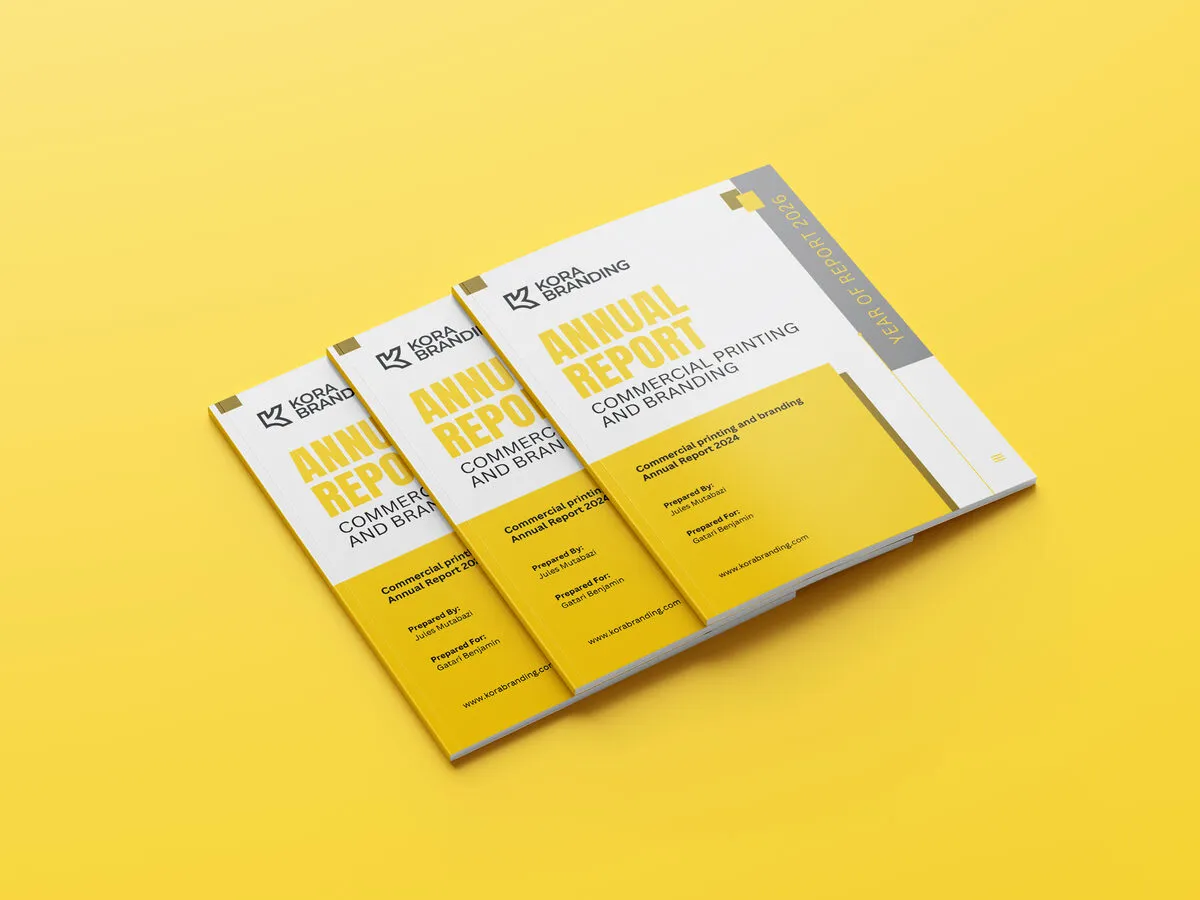
A report or a proposal is often the only thing a funder, a board or a client keeps from months of your work, so it is worth more than a stack of stapled pages. Printing one in Kigali costs less than most people assume: black-and-white pages start at around RWF 100 each, colour pages at RWF 400, spiral binding at RWF 3,000, wire-O at RWF 5,000 and a proper saddle-stitched annual report booklet at around RWF 12,000 a copy. Here is how to choose the binding, how many to print, and what makes a document feel worth reading.
What report and document printing costs in Kigali
These are indicative starting prices at our Kigali studio, before page count, paper and quantity are agreed:
- Document printing, black and white - from RWF 100 a page
- Document printing, full colour - from RWF 400 a page
- Spiral or comb binding - from RWF 3,000
- Thermal binding - from RWF 4,000
- Wire-O binding - from RWF 5,000
- Hardcover binding - from RWF 25,000
- A4 lamination - from RWF 1,000 a sheet
- Saddle-stitched report or booklet - from RWF 12,000 a copy
- Perfect-bound report - from RWF 15,000 a copy
- Thesis printing and binding - from RWF 15,000
- Presentation folders - from RWF 25,000
- Plan and drawing printing, A1 - from RWF 5,000
- Company profile design - from RWF 80,000
Page count and quantity move these numbers most. Send us the final page count, whether the inside pages are colour or black and white, and how many copies you need, and the quote gets sharp within the hour.
Choose the binding for how the document will be used
This is the decision people agonise over and it is simpler than it looks, because the right answer comes from what happens to the document after you hand it over. Spiral or comb binding lets a document lie completely flat and open, which is why it is right for training manuals, workshop handouts, budgets and anything someone will work through with a pen in hand. Wire-O does the same job and looks considerably smarter, so it suits a proposal or a report going to a client or a board. Thermal binding gives a clean glued spine for a modest cost and suits internal reports. Saddle-stitching - folded and stapled through the spine - is what most annual reports and company profiles use up to around 40 pages, and it is the format that reads as a published booklet rather than a printout. Perfect binding gives a square spine you can print a title on, which matters when the document will sit on a shelf among others. Hardcover is for the things that are meant to last: a commemorative report, a strategy document, an anniversary publication, a thesis.
How many to print, and the mistake that wastes money
The most expensive error we see is printing two hundred copies of a report because the price per copy looked better, then finding a wrong figure on page nine, or watching a hundred and sixty of them sit in a store room for three years. Print for the people who will actually hold a copy: the board, the donor, the partners in the room, plus a modest reserve. For everyone else, the PDF is genuinely better, because it is searchable and it costs nothing to send. Short digital runs make this easy - printing forty copies now and forty more in March costs a little more per copy than printing eighty today, and it is far cheaper than reprinting a whole batch because a name or a number changed. Always approve a single printed proof before a full run, and read it on paper rather than on screen. Errors that are invisible on a laptop have a way of leaping off a printed page.
Paper, colour and what makes a report feel substantial
Three small choices separate a document that feels commissioned from one that feels photocopied. The first is the paper weight inside: 100gsm rather than standard 80gsm costs very little more and stops text on the reverse showing through, which is the single most common reason a report feels cheap. The second is the cover: a heavier card cover with a matte laminate protects the document in a bag and gives it a quality it keeps for years. The third is knowing where colour earns its place. Full colour throughout is rarely necessary and multiplies the price - putting colour on the cover, the charts and the photographs while keeping the body text black and white looks deliberate and costs a fraction. If your report has photographs of real work and real people, print those pages properly; they are usually the pages anyone actually looks at.
Proposals that have to win the work
A proposal is judged before it is read, in the two seconds it takes to lift it off a pile. Give it a printed cover with the client's name and the date on it rather than a generic template, bind it so it opens flat during the meeting, and hand it over in a presentation folder with your business card in the slot if the submission is a loose set of documents. For tenders with several sections, ask for printed divider tabs so a reviewer can find the budget or the methodology without hunting. And if you submit proposals regularly, a well-designed company profile that sits behind every one of them saves you rewriting the same three pages about your organisation each time. Our document printing service handles the whole thing, including the last-minute versions.
Plan the deadline backwards
Nearly every rushed report we print is rushed for the same reason: the writing finished the night before the deadline and nobody left time for the printing. Binding is a physical process, and a hundred wire-O copies cannot be produced in twenty minutes however urgently they are needed. Work backwards instead. Fix the final text two working days before you need the copies in your hands, three if the run is large or the binding is hardcover. Send us the file as a print-ready PDF with the fonts embedded and the pages in final order, because a document that has to be reformatted at our end is where the hours disappear - our guide to preparing print-ready files covers exactly what to send. If the deadline is genuinely tight, tell us at the start rather than at the end and we will tell you honestly what is achievable.
Make it look like the rest of your organisation
A report is a brand document as much as a business card is. The same logo, the same colours and the same typefaces should run through the cover, the charts and the page footers, so it plainly belongs to the same organisation as your letterhead and your business card. If your reports have been assembled by different people in different templates over the years, that is worth fixing once: our brand guidelines settle the colours, fonts and chart styles so every future report starts from the same place. For the everyday paperwork that surrounds a report, our guide to business stationery in Kigali covers letterheads, folders and the rest.
How ordering works with us
Send us the final PDF, tell us the page count, whether the inside is colour or black and white, how many copies you need and the date you need them. That is enough for a clear, itemised quote, usually within the hour. We print a single proof copy for you to approve before the full run whenever the schedule allows, your files stay with us so a reprint or a corrected edition is straightforward, and finished documents are delivered across Kigali and anywhere in Rwanda. Browse the full range on our publishing page and our documents page.
Got a report, proposal or profile to print? Send us the page count and your deadline - we'll recommend the right binding for how it will be used and send a clear, itemised quote the same day. Request a report printing quote →