
Company calendars and diaries in Kigali: order by October
2026-09-09 · 7 min
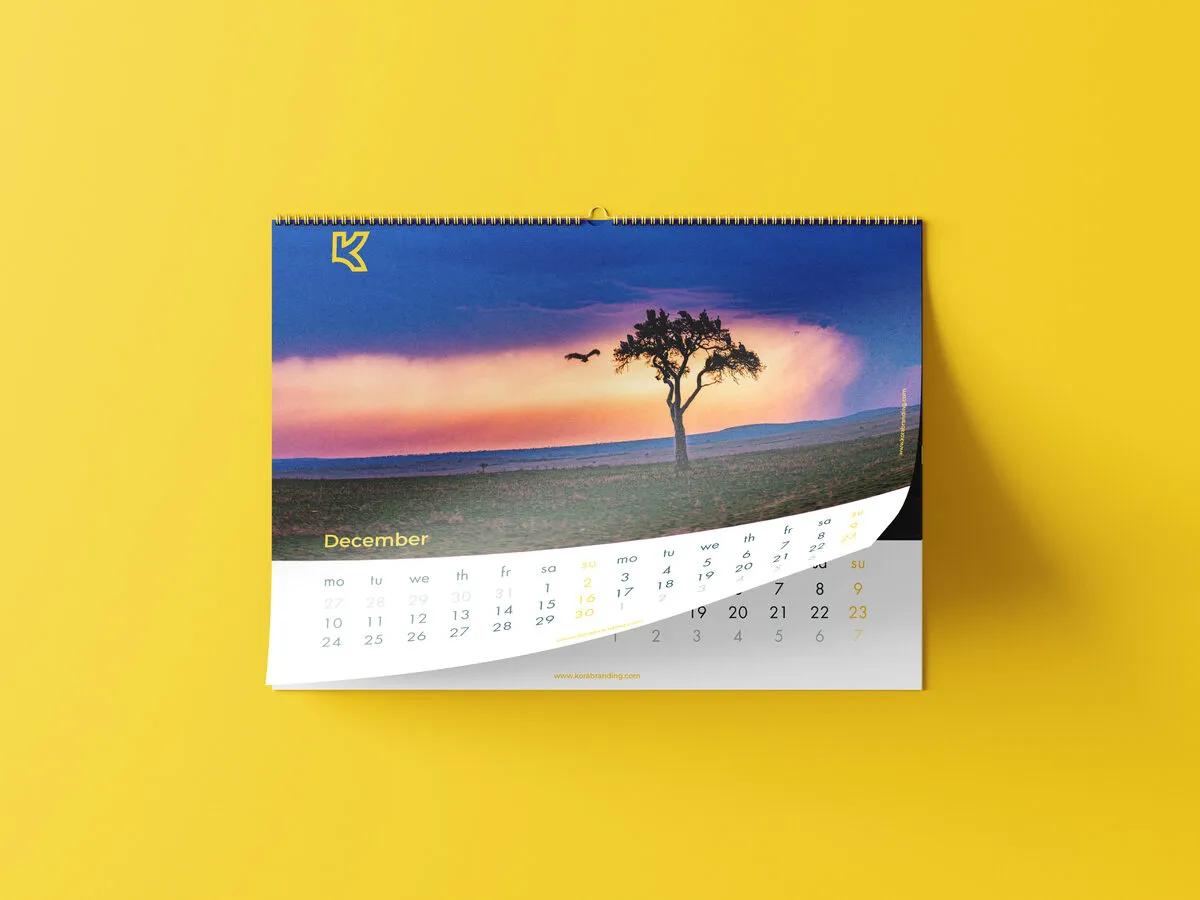
If your company hands out calendars and diaries in December, the order needs to be placed in October. That is the honest answer, and most Kigali businesses learn it the hard way. At our Kigali studio, wall calendars start at around RWF 8,000, desk calendars at around RWF 6,000, branded notebooks and diaries at around RWF 5,000, and a proper gift set at around RWF 25,000. Here is what each item costs, why the October deadline matters more than the price, and how to plan a year-end order that reaches your clients before they close for the holidays.
What calendars, diaries and year-end gifts cost in Kigali
These are indicative starting prices at our Kigali studio, before quantity, paper and finishing are agreed:
- Wall calendars - from RWF 8,000
- Desk calendars - from RWF 6,000
- Branded notebooks and diaries - from RWF 5,000
- Branded pens - from RWF 500
- Branded mugs - from RWF 5,000
- Tote bags - from RWF 4,000
- Keyrings - from RWF 2,000
- Lanyards - from RWF 2,000
- Umbrellas - from RWF 12,000
- USB drives - from RWF 12,000
- Awards and trophies - from RWF 5,000
- Presentation folders - from RWF 20,000
- Gift sets - from RWF 25,000
Quantity moves these figures more than anything else, because artwork, plates and setup are shared across the whole run. A hundred calendars costs far less per piece than twenty. Tell us the real number you need rather than a round guess and the quote gets sharper.
Why October is the deadline, not December
A year-end order has three stages that people forget when they think of it as "just printing": agreeing the artwork, printing and finishing, then delivering and distributing. Each one takes real days, and in November every printer in Kigali is running the same jobs for everybody else at once. Here is the timeline that works:
- Early October - decide quantities, gather your logo files and any photographs you want to use
- Mid October - artwork agreed and the digital mock-up signed off
- November - printing, binding and finishing
- First week of December - delivery, so you can hand items over before offices wind down
The stage that slips is almost always the first one. Artwork sits waiting on one approval from a director who is travelling, and two weeks disappear. Start the conversation in early October and the rest of the schedule holds comfortably. Leave it to late November and you are choosing between paying rush rates and handing out calendars in January, when nobody wants one.
Wall calendar or desk calendar?
They do different jobs, and the honest answer is that most companies should order both in different quantities. A wall calendar is the one that gets hung in a shared space - a reception, a workshop, a staff kitchen, a shop counter - where several people see it every day for twelve months. It is the better buy when you want reach, and it is the one to give to clients who run offices with staff. A desk calendar sits with one person, usually the decision-maker you actually want to stay in front of, and it survives on the desk precisely because it is small and useful. It is the better buy when you want to be remembered by a specific person rather than seen by a room. As a rule of thumb, order wall calendars for the businesses you supply and desk calendars for the individuals you deal with, and expect the desk version to be the one people ask you for again next year.
Diaries and notebooks that survive the year
A branded notebook or diary is the year-end gift with the longest working life, because it goes to every meeting a person attends between January and December. That is also why quality matters more here than on almost anything else you print. A cover that curls, a spine that gives way in March or paper that bleeds through will be quietly replaced with something better, and your logo goes with it. Hardcover with a stitched or spiral binding is worth the small extra over a soft cover for anything meant to last the full year. Keep the branding to a debossed or printed logo on the cover rather than covering every page with it - the person carrying it should feel it is theirs, not a walking advert. If you are giving these to staff as well as clients, order them at the same time; it is one artwork file and one print run, so the per-piece price drops for both.
Choosing year-end gifts for a real client list
Most companies cannot give everyone the same thing, and trying to is how budgets get wasted. Split the list into three and buy accordingly. For the broad list - everyone you invoiced this year, every visitor to your stand - a branded pen, a keyring or a calendar does the job at a few thousand francs a head. For the middle group, the regular clients you want back next year, spend on something that lives on a desk or gets used weekly: a mug, a proper diary, a tote bag or a branded umbrella that earns real gratitude the first time the sky opens over Kigali. For the short list of major clients and partners, a gift set that arrives as one considered package beats three separate items handed over at different times, and an engraved award or trophy is the right choice when you are thanking a long partnership rather than making a giveaway. Our guide to promotional items clients actually keep goes deeper on choosing items people use rather than bin.
What to put on a company calendar
A calendar hangs on a wall for a year, so the design has to survive being looked at hundreds of times. Keep the branding calm: your logo and one contact line, sized so they read from across the room without shouting over the dates. The dates themselves are the product, so make them big, clear and correct - check the Rwandan public holidays for the year before you print, because a calendar that misses Liberation Day or Umuganura is the one that gets taken down. Photographs work well when they are your own work, your team or your premises rather than stock images anyone could have used; a supplier who shows what they actually make is more memorable than one who shows a mountain range. And if the calendar is going to clients in different sectors, leave off anything seasonal or promotional that will look stale by March.
Work out the quantity before the design
Quantity is the decision that sets the whole budget, and it is worth being honest about. Count your actual client list, add your staff, add a reasonable number for walk-ins and new business in January, and stop there. Ordering five hundred calendars because the per-piece price looked good is how businesses end up storing three hundred of them in a cupboard until they are worthless in February. Calendars and diaries are the one print job with a hard expiry date, so unlike business cards or flyers, leftovers cannot be used next year. Order what you will genuinely hand out, and if you are unsure, order the smaller number and reprint - a repeat run from artwork already on file is quick and cheap.
How ordering works with us
Tell us roughly how many pieces you need, who they are going to and your budget, and we will suggest a mix that fits all three - including the times a smaller run of something better will serve you more than a large run of something cheap. That is enough for a clear, itemised quote, usually within the hour. If your logo only exists as a photo or a low-resolution image, say so and we will sort out proper print-ready files rather than printing something blurred; our guide to preparing print-ready files explains what we need, and our artwork setup service covers it if you would rather we handled it. We produce a digital mock-up so you approve the real thing before anything is printed, your artwork stays on file so next year is a phone call, and finished orders are delivered across Kigali and anywhere in Rwanda. Browse the full range on our promotional items page, and see what business stationery costs if you are refreshing the everyday printing at the same time.
Planning your year-end calendars and gifts? Tell us the quantity and who they are going to - we'll recommend a mix that fits your budget and send a clear, itemised quote the same day. Request a year-end quote →