
Office branding in Kigali: what it costs
Divine Uwicyeza · 21 September 2026 · 7 min read
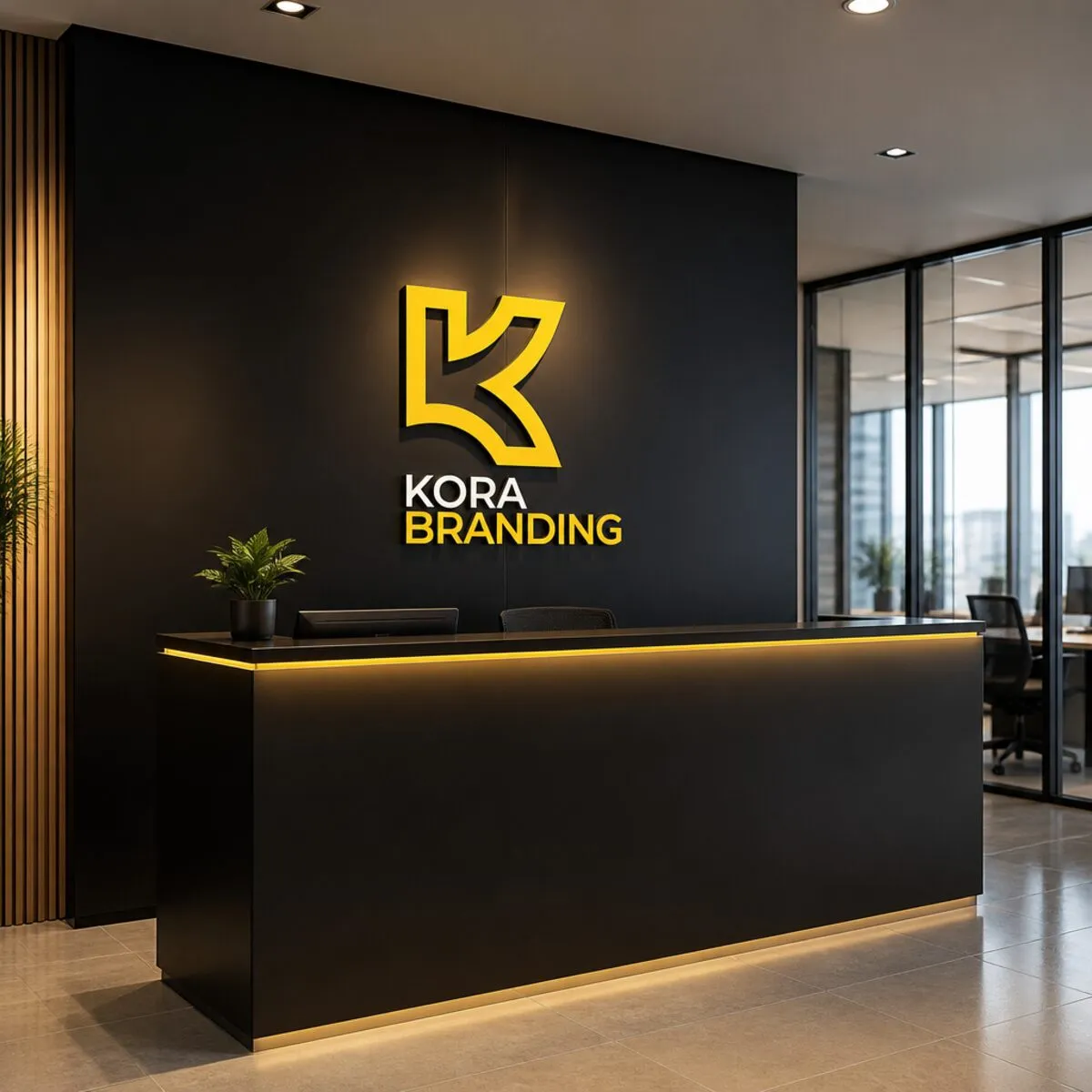
Office branding is everything a business prints inside its own walls: the sign behind reception, the frosted film on the meeting-room glass, the door numbers, the safety signs and the photographs along the corridor. At our Kigali studio an acrylic reception sign starts at around RF 49,900 per A4, frosted window film at RF 29,900 per sqm, a wall mural at RF 39,900 per sqm, door signs at RF 29,900 and safety signs at RF 9,900 per A4. Built-up 3D letters, the reception wall most companies picture, start at around RF 39,900 per letter. Here is what each piece costs, what to do first when the budget is small, and how to plan an office that still looks right in three years.
What office branding costs in Kigali
These are indicative starting prices at our Kigali studio for a single item, before size, material, quantity and installation are agreed:
- Acrylic reception and panel signs - from RF 49,900 per A4
- 3D built-up letters - from RF 39,900 per letter
- Lightbox signs - from RF 149,000 per sqm
- Neon-style signs - from RF 45,900 per letter
- Window graphics and frosted film - from RF 29,900 per sqm
- Wall murals and wall graphics - from RF 39,900 per sqm
- Canvas prints - from RF 49,900 per sqm
- Framed prints - from RF 29,900
- Door and office signs - from RF 29,900
- Safety and fire signs - from RF 9,900 per A4
- Floor graphics - from RF 24,900 per sqm
- Custom stickers and vinyl lettering - from RF 39,900 per sqm
- Desk and counter stands - from RF 4,900
- Desk flags - from RF 9,900
- Staff ID cards - from RF 3,900
- Printed lanyards - from RF 2,900
- Certificates and awards frames - from RF 1,500
- Roll-up banners for reception - from RF 79,900
The price depends mostly on two things. Size comes first, because every one of these items is priced by the square metre of material and the time it takes to fit. Installation comes second: a sign fixed to a plasterboard partition at desk height is a quick job, while letters mounted three metres up a concrete wall need scaffolding, drilling and two people. Send us the measurements and a photo of the wall and the estimate turns into a firm quote.
Start with the wall behind reception
If you only brand one surface, brand the one every visitor looks at while they wait. The wall behind the reception desk is the office equivalent of a shopfront, and it does three jobs at once: it tells people they are in the right place, it gives staff a backdrop for photographs that end up on LinkedIn and in reports, and it settles how serious the company looks before anyone has said a word. There are three usual ways to do it. A printed acrylic panel with your logo mounted on standoffs is the affordable choice and suits a rented space you may leave in two years. 3D built-up letters fixed straight to the wall are what established companies choose, because the shadow behind each letter is what makes a logo read as permanent. A lightbox or neon-style sign is the right answer when the reception area is dim or when the brand is meant to feel modern rather than formal. Whichever you pick, size it against the wall rather than against your budget. The most common mistake we fix in Kigali offices is a logo that would look right on a business card sitting alone on a four-metre wall.
Frosted glass: privacy and branding in one job
Most new offices in Kigali are built with glass partitions, and most of them end up with paper taped over the meeting-room glass within a month. Frosted window film solves that properly. A band of frosted vinyl at sitting height gives a meeting room privacy without making it dark, it stops people walking into clear glass, and your logo or a pattern can be cut into the film so the same job does the branding. On external windows, printed or frosted film also cuts the glare that makes screens unreadable on a sunny Kigali afternoon, and it keeps the room cooler. Prices start at around RF 29,900 and are worked out by the square metre, so a single meeting room is a small job and a whole floor is a project worth planning in one go. Ask for the film to be fitted by us rather than doing it yourself: bubbles and dust under vinyl are permanent, and glass is the one surface where a bad fit is visible from across the room.
Door signs, wayfinding and the signs you are required to have
Wayfinding is the quiet half of office branding, and it is what visitors judge you on when nobody is at the desk to guide them. A consistent set of door signs - room names or numbers, the boardroom, the finance office, the toilets - costs very little and removes the small daily friction of people opening the wrong door. Keep them in one material, one font and one position on every door, roughly at eye height, and they read as a system rather than a collection. Directional signs matter most in buildings where your floor is shared with other tenants, and in plazas where the lift lobby gives no clue which office is yours.
Then there are the signs you are obliged to display. Fire exit, extinguisher, first aid, assembly point and no-smoking signs are a legal and insurance requirement, not decoration, and they are checked during inspections. They start at around RF 9,900 per A4, they must use the standard symbols and colours rather than your brand palette, and the photoluminescent versions are worth it for exit routes because they stay visible when the power goes. If you are fitting out a new office, order the safety set at the same time as the branding rather than three weeks later in a hurry.
The rest of the floor: walls, corridors and desks
Past reception, the aim is a building that feels like one company rather than a set of rented rooms. Wall murals and printed wall graphics do the heavy lifting in open-plan areas, stairwells and long corridors, and they work best when they carry something real: your values in plain words, a timeline of the company, a map of where you work, a large photograph of what you actually make. Framed prints and canvas prints are the flexible version of the same idea and the better choice in a rented space, because they move with you. Corridors are also the right home for certificates, licences and awards, framed to a single size so the wall looks deliberate.
Small items finish the job. Desk and counter stands for reception notices, desk flags in the boardroom, branded notebooks and pens on the meeting table, mugs in the kitchen, and staff ID cards on printed lanyards, which are the cheapest thing on this list and the one visitors notice most. Our guide to promotional items clients actually keep covers the desk items in more detail.
What to brand first when the budget is small
Very few businesses fit out an office in one order, so spend in this sequence. First, the reception sign, because it is the only piece every single visitor sees. Second, the safety signs, because they are required and cheap. Third, frosted film on the meeting-room glass, because it buys privacy as well as branding. Fourth, door and wayfinding signs, so the office runs itself. Fifth, wall graphics and framed prints in the areas where people wait or walk. Everything else, from desk flags to branded mugs, is a finishing touch that can wait for next quarter. If your everyday printing needs sorting out at the same time, our guide to business stationery in Kigali covers letterheads, stamps and folders, and branding a new business in Rwanda sets out what to print first when you are starting from nothing.
Materials, measurements and the Kigali details
An office is an easier environment than a shopfront, but a few local details decide whether the job lasts. Interior acrylic and aluminium hold up indefinitely, so the risk is not weather but walls: freshly painted surfaces need a few days to cure before anything is fixed to them, and dusty or unpainted blockwork needs mechanical fixings rather than tape. Direct sun through a large window will fade a cheap print within a year, so anything hanging in the light should be printed with UV-stable inks. In rented offices, ask your landlord what you are allowed to drill before you order, because standoff-mounted panels and 3D letters both need holes; where drilling is out of the question, we use heavy-duty tape systems or free-standing options instead. Measure the wall, take a photograph with a person or a door in the frame for scale, and note the ceiling height. And send your logo as a vector file rather than a photograph of a business card: the difference is a crisp cut edge or a fuzzy one, and our guide to preparing print-ready files explains what we need. Our artwork setup service handles it if your files are a mess.
What to send us to get started
Send us photographs of the space, the measurements of the main walls and glass, and your logo files. With that we can send an itemised quote, usually in under 30 minutes during opening hours. We produce a digital mock-up showing the sign on your actual wall so you approve the real thing before anything is made, we install across Kigali and anywhere in Rwanda, and your artwork stays on file so the next room, the next branch or a replacement panel is a short WhatsApp message, not a fresh job. If your shopfront needs attention at the same time, our guide to shop signage in Kigali covers the outside of the building. Everything we offer is on our signs and displays page.
Fitting out or refreshing an office? Send us photos of the space and your logo - we'll recommend what to brand first, what it costs installed, and send a clear, itemised quote the same day. Request an office branding quote →
Ready to print this?
Send us the product and the quantity: quote in under 30 minutes during opening hours.