
Flyers and brochures in Kigali: what they cost
2026-09-14 · 8 min
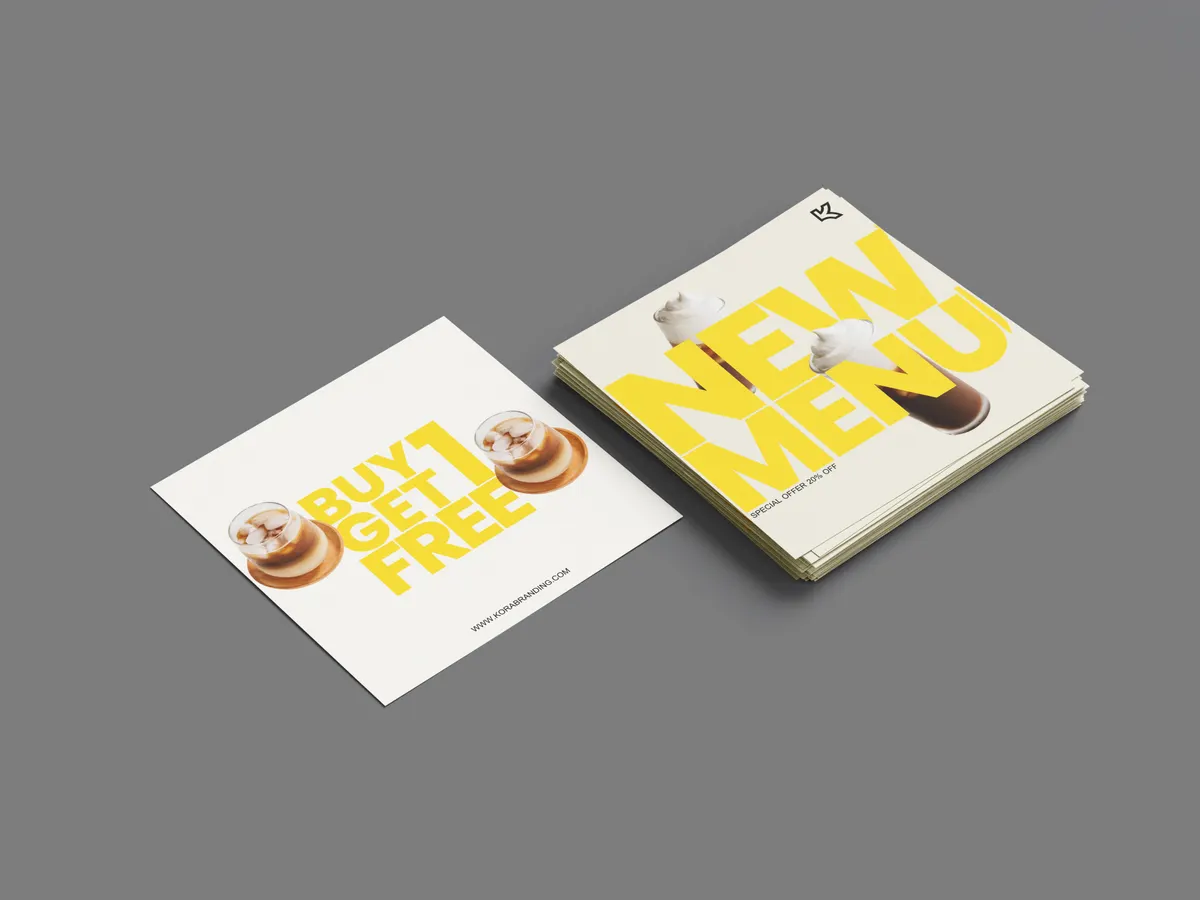
A flyer is a single printed sheet with one message, made to be handed out. A folded leaflet carries more detail, like a menu or a price list. A brochure tells your whole story and stays on someone's desk, and a poster is read from across a room. Pick the one that matches where your customer will meet it. On price, flyers start at around RWF 15,000 at our Kigali studio, folded leaflets at RWF 18,000, brochures at RWF 25,000 and posters at RWF 3,000, before size, paper and quantity are agreed. Here is what each one costs, which size and paper to choose, and how many to print so half the box does not end up in a cupboard.
What flyers, brochures and posters cost in Kigali
These are indicative starting prices at our Kigali studio for the smallest order of each item, before size, paper, finishing and quantity are agreed:
- Flyers and leaflets (A6 to A4, DL) - from RWF 15,000
- Folded leaflets (half-fold, tri-fold, Z-fold) - from RWF 18,000
- Brochures (bi-fold, tri-fold, gate-fold) - from RWF 25,000
- Catalogues and booklets - from RWF 40,000
- Posters (A3 to A0) - from RWF 3,000
- Postcards - from RWF 12,000
- Door hangers - from RWF 20,000
- Menus - from RWF 10,000
- Flyer and poster design - from RWF 20,000
- Brochure and catalogue design - from RWF 50,000
- Artwork and file setup - from RWF 15,000
Two things move these numbers more than anything else. Quantity comes first: the setup is shared across the whole run, so 1,000 flyers cost far less per piece than 100. Paper comes second: a 350gsm card flyer costs more than a 130gsm gloss one of the same size, and it should, because it does a different job. Tell us the real number you need and what the piece is for, and the quote gets sharper.
Flyer, leaflet, brochure or poster?
They look alike on a price list, but they do different jobs, and choosing the wrong one is where most marketing print budgets leak.
- Flyers - one sheet, one message, one action. Use them for an opening, a promotion, an event or a new service, handed out in person or dropped into delivery orders. They are meant to be read in ten seconds.
- Folded leaflets - more room without more paper. A tri-fold A4 folds down to DL size and fits a pocket, which is why it is the usual choice for price lists, takeaway menus, clinic information and tourist guides.
- Brochures - your full story, for someone deciding whether to work with you. Services, past clients, photographs and contacts on heavier paper, for sales meetings, reception desks and tender submissions.
- Catalogues and booklets - stapled or bound pages for a full product range, a training prospectus or an event programme, when a fold is no longer enough.
- Posters - read from a distance, usually by people walking past. Shop windows, notice boards, office corridors, campus walls and event venues.
A simple test: if the person will glance at it, print a flyer or a poster. If they will sit down with it, print a leaflet or a brochure. If they will keep it for months, print it on card.
Which size to choose
Four sizes cover almost every flyer and leaflet printed in Kigali:
- A6 (105 x 148mm) - postcard size. The cheapest per piece, ideal for handouts, vouchers and inserts in delivery bags. Room for one headline, one offer and a contact line, no more.
- A5 (148 x 210mm) - the everyday flyer. Enough space for a photograph, a short list of services and a map or QR code, and still easy to hold in one hand. If you are unsure, start here.
- DL (99 x 210mm) - tall and slim. It fits a standard envelope, a jacket pocket and a hotel brochure rack, which makes it a favourite for tourism, hospitality and price lists.
- A4 (210 x 297mm) - a full page. Better for information sheets, notices and tri-fold leaflets than for handing out on the street, where it gets folded into quarters and pushed to the bottom of a bag.
Posters work the other way round: the size depends on how far away people will be. A3 is fine for a notice board or a counter, A2 for a shop window or a corridor, and A1 or A0 when people will read it from across a hall or a car park. If it needs to be seen from further than that, you are really looking at a banner or window graphics, and our guide to banners and roll-up stands covers those.
Paper weight and finish, in plain words
Paper weight is measured in gsm, grams per square metre. The higher the number, the thicker and stiffer the sheet. These are the four papers on our flyer order form and what each one is for:
- 130gsm gloss - light and economical. Right for large handout runs and inserts where the flyer has a short life.
- 170gsm gloss - noticeably more solid in the hand, and the safe default for most flyers and folded leaflets. Colours and photographs look bright.
- 250gsm matte - a heavier, calmer feel that reads as premium. Good for brochure covers, professional services and anything people might write on.
- 350gsm card - business card weight. Use it for vouchers, loyalty offers, counter price cards and anything you want kept for months.
Lamination is a thin film over the print. Gloss lamination makes colours pop and wipes clean, which is why it suits menus and price lists handled all day. Matte lamination feels smooth and expensive and hides fingerprints. Most handout flyers need neither, so save lamination for pieces that will be touched again and again. For posters we also print on weatherproof synthetic material, which is the one to choose if a poster is going anywhere near rain or direct sun. And print double-sided whenever you have something useful for the back, such as a map, opening hours or a price list. It usually costs far less than a second flyer, and the sheet does twice the work.
How many to print
Quantity is where flyer budgets are won or lost, and the per-piece price is a trap. A thousand flyers look like good value next to two hundred and fifty, until seven hundred of them are still in the box three months later. Work it out from the other end instead:
- Count your real distribution. How many people will you actually hand one to - at an event, across the counter, in delivery bags - in the next four to six weeks?
- Split dated from evergreen. Anything with a date, a price or an offer on it expires, so print those small and close to the day. A general flyer about your services can be printed in a larger run and used for months.
- Reprint rather than over-print. Once your artwork is on file, a repeat run is quick, and it lets you fix the phone number or the price that changed in the meantime.
Our order form runs from 100 up to 5,000 flyers. For a new shop or a first promotion, 250 to 500 is a sensible start. For an event, count your expected guests and add around a fifth for the people who take one for a colleague.
What to put on a flyer that gets a reply
The flyers that work in Kigali all do the same few things. They make one offer, not twelve: a new shop opening, a weekend discount, a single service. They tell people exactly what to do next, and in Rwanda that usually means a phone number that works on WhatsApp, printed large enough to read without glasses. They say where you are in words people actually use, such as a building name or a well-known landmark nearby, because a street number alone rarely gets anyone to your door. And they carry a QR code that opens your WhatsApp chat, your menu or your location on Google Maps, tested on two phones before anything goes to print.
Think about language too. A flyer for a Kigali office crowd can be in English, but one for a neighbourhood shop, a market or a district activity usually reaches more people in Kinyarwanda, with English or French alongside if there is space. Photographs of your real products, premises or team beat stock images every time. If your file is not ready, our flyer and poster design service can build it from your logo and a few lines of text, and our guide to preparing print-ready files explains bleed, colour mode and resolution if you are designing it yourself.
Where marketing print earns its money
Where a piece ends up matters as much as what is printed on it. A few placements reliably pay their way for Kigali businesses:
- Inside every order. A small A6 flyer in delivery bags and takeaway boxes reaches people who already buy from you, which makes it the easiest repeat sale you will get. Our guide to printing for restaurants and cafés goes further on this.
- On the counter and at reception. A table tent or a stack of DL leaflets in a holder works quietly all day, with nobody needing to hand anything out.
- At events and expos. Brochures and leaflets for the people who stop at your stand, and a flyer for everyone else. Many visitors carry paper back to their hotel and read it later. Our conference printing guide covers the full stand kit.
- Door to door. For estates, apartment blocks and office buildings, door hangers stay where they are put, unlike a flyer pushed under a door.
- In windows and on notice boards. Posters in your own window, at partner businesses and on campus boards. Ask the owner first before putting posters up anywhere that is not yours.
How ordering works with us
Tell us what the piece is for, roughly how many you need and when you need them, and send your logo or finished file. That is enough for a clear, itemised quote, usually within the hour. We produce a digital proof so you approve the real thing before anything is printed, your artwork stays on file so the next run is a phone call rather than a fresh job, and finished orders are delivered across Kigali and anywhere in Rwanda. If you are launching a business and need the whole set at once, our guide to branding a new business in Rwanda shows what to print first. Browse the full range on our marketing print page, or see brochure design if you want a brochure designed and laid out from scratch.
Planning a flyer, leaflet or brochure run? Tell us what it is for and how many people you need to reach - we'll recommend the size, paper and quantity and send a clear, itemised quote the same day. Request a print quote →